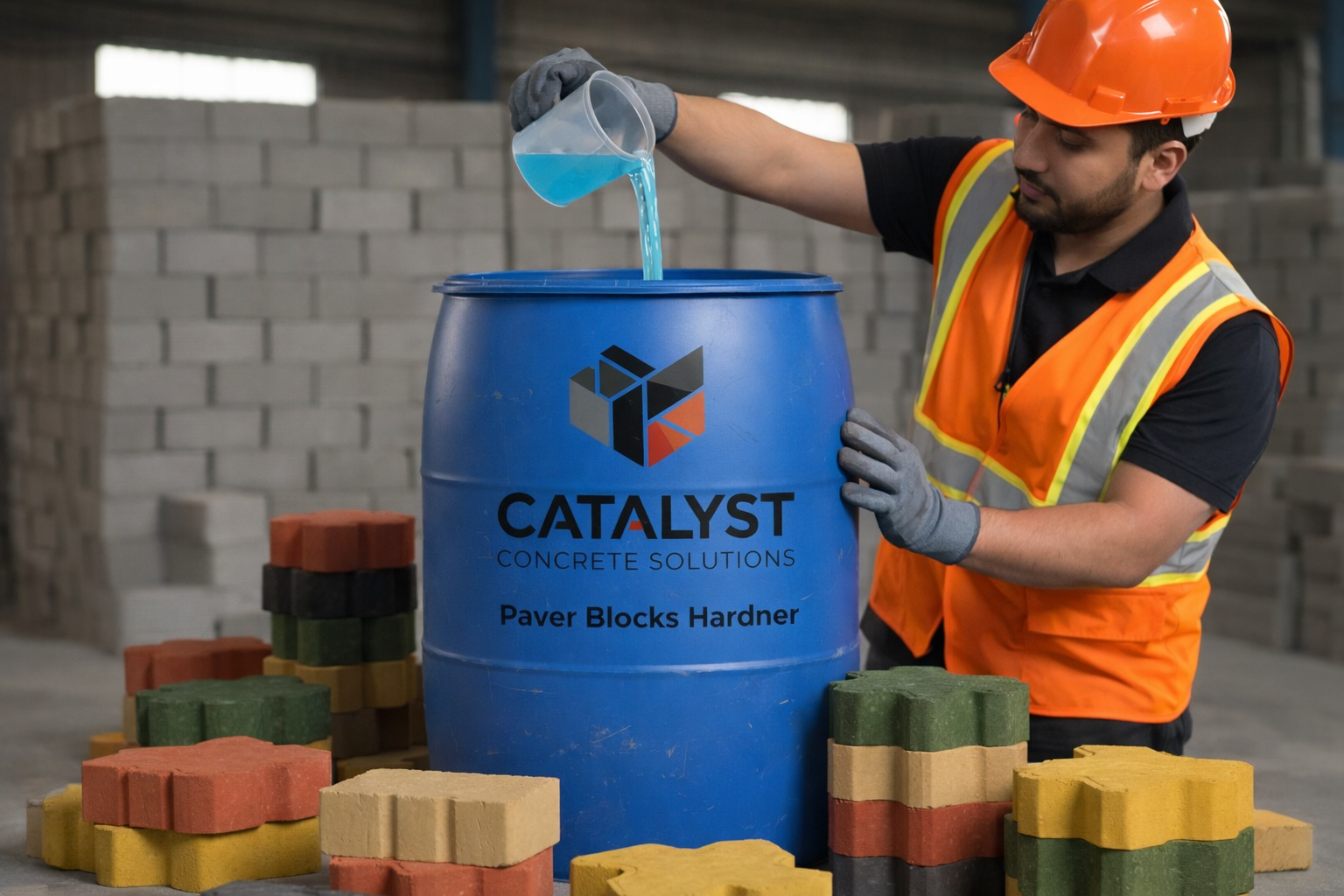
Concrete Block Hardener Chemicals

Plasterproof - Smart Admixture

Concrete Block Hardener Chemicals

Overview

Concrete Block Hardener Chemicals are specialized construction admixtures used to accelerate the curing process, increase compressive strength, and enhance the surface finish of precast products like paver blocks, AAC blocks, and interlocking tiles.

Common Chemical Compositions – Yellow Theme

Common Chemical Compositions

01

Silicate-Based Compounds

Often using Sodium Silicate, Potassium Silicate, or Lithium Silicate. These react with free lime to form Calcium Silicate Hydrate (CSH), the primary compound responsible for concrete's strength.

02

Polycarboxylate Ether (PCE) Based

Modern high-performance hardeners use PCE as an ultra-high water-reducing accelerator to achieve early strength without sacrificing workability.

03

Accelerator Salts

Calcium Chloride is a traditional, cost-effective accelerator often used in cold weather to speed up hydration.

04

Polymer & Silicone Blends

Specialized admixtures using melamine, silicone, or naphthalene bases provide a glossy finish and superior water resistance.

Key Benefits & Application

Key Benefits

  • Faster Production: Reduces setting time (often by 6–8 hours), allowing for earlier de-molding and stacking of blocks.
  • Enhanced Strength: Increases both early and final compressive strength by over 25%, minimizing breakage during handling.
  • Improved Aesthetics: Provides a smooth, glossy, or "shining" surface finish and helps maintain color brightness in light-colored blocks.
  • Durability & Protection: Densifies the surface to prevent "dusting," reduces water permeability, and improves resistance to chemicals and weathering.

Application & Dosage

  • Form: Available as a liquid (easiest for uniform dispersion) or powder.
  • Usage: Usually added to the concrete mix during the initial mixing phase, often pre-diluted with water.
  • Dosage: Varies by product; for example, some liquid accelerators recommend 100ml per 50kg bag of cement, while others suggest 1kg per 100kg of total mixture.